USDC competes with the bank. USDT competes with the dollar.
The BIS has just measured, for the first time, whether stablecoins pull deposits away from banks. The answer is yes for USDC and barely for USDT. That changes the regulatory conversation in Latin America: the risk is not the term deposit, it is the dollar.
Author
Juan C. Pryor
Category
Research
Read Time
10 min read
Published
14 Oct, 2026
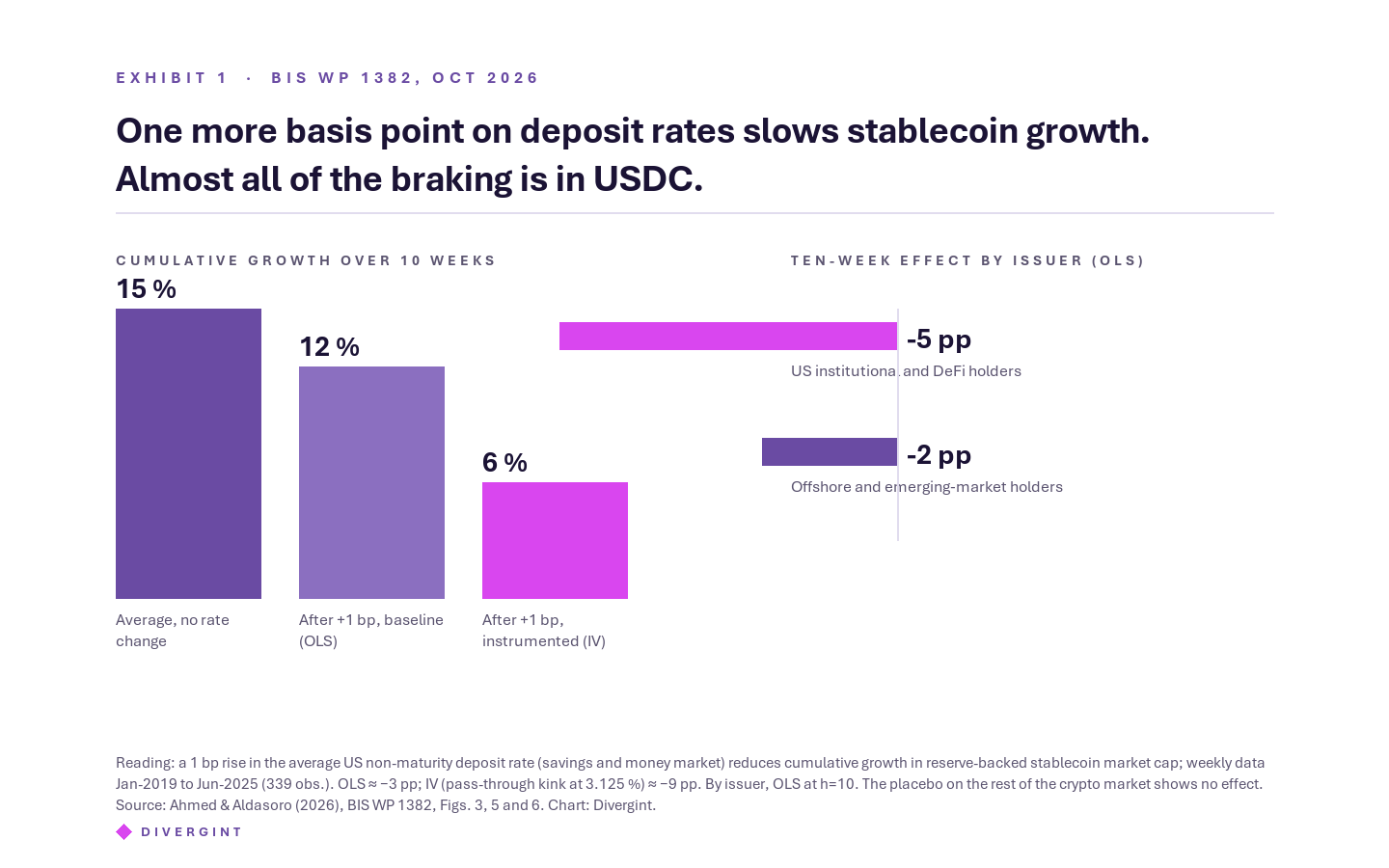
The number. On weekly US data from January 2019 to June 2025, a one basis point rise in the rate banks pay on non-maturity deposits cuts ten-week growth in stablecoin market capitalisation by about three percentage points: from an average of 15 % to roughly 12 %. Almost all of the effect sits in USDC. In USDT it is weak.
For years US banks argued that stablecoins cause deposit flight and the crypto industry argued that they do not. Neither side had a number. They had an assumption, built into Federal Reserve models, into the trade associations’ letters to the Senate and into issuers’ pitch decks. On 13 October the Bank for International Settlements published the first serious attempt to measure it. It is titled Are stablecoins and bank deposits substitutes?, published by Rashad Ahmed and Iñaki Aldasoro. The short answer is that they are substitutes, with caveats.
What they measured and how
How many deposits have banks lost to stablecoins? That cannot be answered yet: the market is young, small next to the US banking system and, being a global market, there is no data on where holders live. So the authors ask the prior question, which can be answered: does demand for stablecoins respond to what banks pay on deposits? The result is that it does, because the two compete on the same portfolio margin.
The authors took the weekly market capitalisation of reserve-backed stablecoins (from under US$5 billion in 2019 to over US$220 billion by mid-2025), built a regression against changes in the average rate on US savings and money market accounts, and sought to control for the federal funds rate, Treasury yields, the bitcoin price, the dollar index and the VIX.
They reached three preliminary conclusions. First, one basis point of deposit-rate increase trims ten-week growth by about three percentage points. Second, the crypto market cycle has no effect. Third, and this is where it gets interesting, the effect is concentrated in USDC. In the baseline specification USDC falls close to 5 % over ten weeks per basis point; USDT close to 2 %. Dropping the Silicon Valley Bank episode, controlling for DeFi yields, swapping deposit rates for certificate-of-deposit rates, moving the instrument’s threshold: none of them materially changed the conclusion.
The three caveats
The paper would seem to prove the banks right on the substance. And that was to be expected: any money market instrument (AAA corporate bonds, for instance) competes with bank deposits at the institutional level. These caveats are worth keeping in mind before repeating the findings from the rooftops.
It is growth, not level. Stablecoin capitalisation does not fall when rates rise; it grows more slowly. Wiping out average ten-week growth would take a five basis point jump in a single week, a six-standard-deviation event. Capitalisation did fall about 30% in the 2022 and 2023 cycle, but that coincided with the Terra and FTX collapses; the rate was one factor among several.
The sample covers a single high-rate cycle and a regime in which stablecoins pay holders no interest. The authors themselves warn that the instrument is somewhat weak and that yield-bearing stablecoins and tokenised money market funds may move the substitution margin in either direction.
It does not say who loses the deposits. The data is aggregate. Dollars that enter a stablecoin are reinvested in Treasuries and in the issuers’ deposits at a handful of banks; the net result may be a reallocation across institutions rather than a loss for the system. The paper says so explicitly, and it is incidentally the best explanation of why US community banks care so much about this debate: the effect is strongest against certificates of deposit, which are their funding.
USDT is the stablecoin of people who have no bank
Why does USDC respond to US deposit rates while USDT barely does? The authors attribute it to the holder base: USDC sits with US institutions and DeFi users who can move into a money market account in an afternoon; USDT circulates mostly outside the United States and in developing economies. It is not a preference for issuer quality. It is a difference in the alternative available.
That explanation says something nobody in Latin America is putting this way: the USDT holder in Bogotá, Buenos Aires or Caracas is not choosing between USDT and a dollar deposit at a New York bank, because that deposit is not available to them. They are choosing between their local currency and the dollar. USDC is a treasury product for people who already have a bank. USDT is a dollar-access product for people who do not. Two different businesses on the same technology, and the regulation that fits one does not fit the other.
There is a second layer. In March, Aldasoro published with the International Monetary Fund a study of what stablecoin flows do to foreign exchange markets in emerging economies. Across 27 currency pairs and four dollar stablecoins they found that a 1 % increase in net stablecoin inflows into a currency widens the gap between the dollar bought via stablecoin and the spot dollar by about 40 basis points, depreciates the local currency and widens covered interest parity deviations. The effect multiplies when financial intermediaries are undercapitalised, which is when it hurts most.
Read together, the two papers say one thing: in the United States the stablecoin competes with the deposit; in emerging markets it competes with the dollar.
And both regulated blocs are pushing USDT out of their markets
The separation the BIS measures in the data is being written into the rules by regulators. In January 2027 USDT leaves the regulated platforms of the European Union and, in the United States, enters a countdown that ends in July 2028.
In the European Union, MiCA’s transition period ended on 1 July 2026 and Tether never applied for authorisation as an issuer. The major platforms had already removed USDT for their European clients. On 8 October ESMA closed the remaining door: in an opinion addressed to national supervisors it said that MiCA-authorised providers should not provide services on asset-referenced tokens or e-money tokens that do not comply with the regulation.
In the United States the clock is set by the GENIUS Act. Its effective date is expected to be 18 January 2027. From that day, a digital asset service provider cannot offer a foreign-issued stablecoin in the United States unless the issuer can comply, and does comply, with lawful freeze and seizure orders. From 18 July 2028 it cannot offer any stablecoin that does not come from a permitted issuer or a recognised foreign issuer, and that recognition requires Treasury to declare the home regime comparable, which it has not yet done for any jurisdiction. Tether read the signal: in January it launched USAT, a separate stablecoin issued in the United States under the GENIUS regime, and left USDT for the rest of the world.
This reinforces the reading rather than contradicting it. If the two markets with deep banking and strong regulators push USDT off their platforms, the USDT holder will increasingly be someone outside those systems: in Latin America, Africa, emerging Asia. The dollar-access product becomes even more evident, and the gap the BIS measured on data through June 2025 should widen over the coming years. For a Latin American regulator the question is no longer whether USDT competes with its banks; it is whether to follow the European expulsion model or to recognise the dollar-access function it serves and regulate it as an equivalence function, in line with the parameters the Trump administration set for international trade to settle in dollar-denominated stablecoins.
What it changes for Latin America
The bank deposit flight argument has no evidence in Latin America yet. The BIS paper shows why the effect is neither monetary nor credit-related: the substitution is in USDC and among holders with access to US banking; the stablecoin that circulates in the region is USDT, whose holders have no such access. Anyone citing the BIS to call for stablecoin restrictions first has to explain why a result about US money markets applies to a peso saver who buys USDT as a hedge.
The main argument is the foreign exchange effect. If what USDT does in the region is provide dollar access outside the formal FX market, the risk a central bank should measure is pressure on the exchange rate, parity gaps and erosion of capital controls. A stablecoin framework for Colombia designed against the wrong risk will impose costs on local issuers without touching the flow that actually matters, which comes in through USDT and offshore exchanges, since it is a global market that cannot be controlled.
A payments fintech holding USDC float to pay suppliers is exactly the marginal agent in the BIS paper: its opportunity cost rises with rates and should be managed like any cash position. A regional issuer that pays holders nothing and is not required to hold reserves in local deposits competes little with local banks, and now has the evidence to show it. Any monetary policy conversation about stablecoins should arrive with both analyses in hand.
The context that makes this urgent
The same paper identifies the two levers with which a regulator moves the substitution margin: requiring part of a stablecoin’s reserves to sit in bank deposits, and allowing or prohibiting the issuer from paying holders. These are the two points on which consensus broke in Washington. On 15 September the Senate failed to advance the crypto market structure bill; stablecoin yield was one of the two obstacles. On 2 October the community banks’ trade association sued the federal bank supervisor for granting trust charters to stablecoin firms. The BIS published its number eleven days later. The fight being waged in the Senate and the courts in the United States will reach the region with the disintermediation argument out front. Better to arrive first with the data, and we do not have it yet.
Designing a stablecoin product for the region, or answering a regulator who has already asked? Write to us with the model and the jurisdiction. You will get a one-page note with the risk map that applies to your case, free of charge.
Sources: Ahmed, R. and Aldasoro, I. (2026), Are stablecoins and bank deposits substitutes?, BIS Working Papers No 1382, 13 October 2026 (weekly data January 2019 to June 2025; OLS estimate of −3 pp and instrumental-variable estimate of −9 pp per basis point at ten weeks; USDC close to −5 % and USDT close to −2 % under OLS). Aldasoro, I., Beltrán, P. and Grinberg, F. (2026), Stablecoin Inflows and Spillovers to FX Markets, IMF Working Paper 26/56 (also BIS Working Paper No 1340), March 2026 (27 currency pairs; +1 % net inflows ≈ +40 bp parity deviation). CLARITY Act cloture vote, US Senate, 15 September 2026, per CNBC and Orrick. ICBA v. OCC, US District Court for the District of Columbia, filed 2 October 2026, per Reuters. ESMA, Opinion on the provision of crypto-asset services in relation to non-MiCA-compliant asset-referenced tokens and e-money tokens, ESMA75-113276571-1742, 8 October 2026 (legacy exposures to be remediated no later than three months after publication; residual services limited to sell, convert, withdraw and transfer). GENIUS Act (Pub. L. 119-27, 18 July 2025), sections 3 and 18; US Treasury, GENIUS Act Regulations on Payment Stablecoin Issuance, Offer, and Sale, proposed rule, 91 Fed. Reg. 53368, 18 August 2026 (expected effective date 18 January 2027; prohibition on providers offering stablecoins from non-permitted issuers from 18 July 2028). The Latin American readings are Divergint’s, not the authors’. This article is general information as of October 2026 and is not legal advice.